Investigative Research Report · Updated February 2026 · 15 Topics · Peer-Reviewed Sources
Investigative Report
The Chemical Gap: What's in Your Food, Water & Body That the US Still Allows
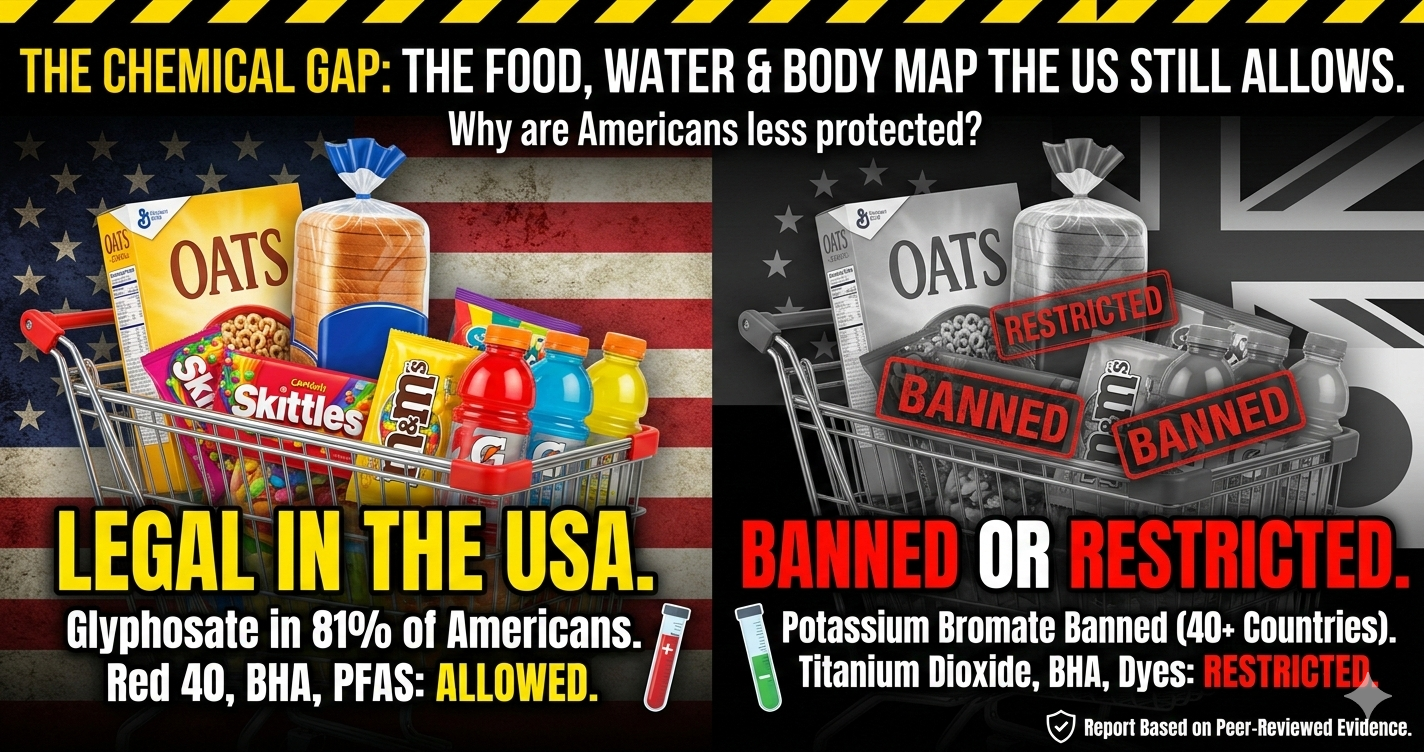
The United States permits over 10,000 chemicals in its food supply — roughly 3,000 of which have never been reviewed by the FDA. The EU bans or restricts hundreds of these same substances. America assumes chemicals are innocent until proven harmful, often after decades of human exposure. This is the deepest available breakdown.
10,000+
Chemicals permitted in the U.S. food supply
~3,000
Never reviewed by the FDA
81%
Americans with detectable glyphosate in urine
97%
Americans with PFAS "forever chemicals" in blood
2,500+
Cosmetic chemicals banned by EU — vs. ~11 by FDA
ZeroPoint IT Research·February 2026·~25 min read
Share this report
If this disturbed you, someone you know needs to see it.
Glyphosate is in 80% of Americans — and the newest science is alarming
Glyphosate, the active ingredient in Roundup, is the most widely used herbicide on Earth. The U.S. applies roughly 150,000 tons per year — about one pound per American. CDC biomonitoring data from NHANES (2013–2018) found detectable glyphosate in 81% of Americans aged 6 and older, with 87% of children testing positive (Ospina et al., Environment International, 2022). A French study found glyphosate in 99.8% of nearly 7,000 urine samples.
The 2024–2025 studies that changed the conversation
The Global Glyphosate Study from Italy's Ramazzini Institute, published in Environmental Health (June 2025), is the most comprehensive independent animal study ever conducted on glyphosate. Rats exposed to doses currently deemed "safe" by regulators — including the EU's Acceptable Daily Intake — developed early-onset leukemia at all dose levels plus tumors in skin, liver, thyroid, nervous system, ovary, mammary gland, kidneys, bladder, and other organs. The study was conducted in collaboration with the U.S. National Institute of Environmental Health Sciences.
A January 2025 study in PNAS found glyphosate exposure in rural areas significantly reduced birthweight and gestational length, with effects on the lowest-income births 12 times larger than on the highest. A December 2024 study in the Journal of Neuroinflammation found mice exposed to glyphosate developed significant brain inflammation linked to Alzheimer's-like pathology. A June 2024 study detected glyphosate in the sperm and blood plasma of infertile French men for the first time. A 2024 review in Frontiers in Toxicology confirmed glyphosate accumulates in kidneys, liver, and colon, and is detected in the biological fluids of 60–80% of the general population.
Which foods have the most glyphosate — and why
EWG's testing found the highest levels in oat-based products. Quaker Oatmeal Squares Honey Nut topped the list at 2,837 ppb — nearly 18× EWG's health benchmark of 160 ppb. EWG's initial 2018 round found 43 of 45 conventionally grown oat products tested positive. Over 90% of non-organic hummus and chickpea samples also contained glyphosate.
Pre-harvest desiccation: Farmers spray glyphosate directly on crops 1–2 weeks before harvest to kill the plant and speed drying. The crop absorbs the herbicide as it dies — resulting in far higher residues than standard weed-control applications. Charles Benbrook of Johns Hopkins estimates pre-harvest use may be only 2% of total glyphosate use but accounts for over 50% of dietary exposure.
Product
Glyphosate (ppb)
vs. 160 ppb benchmark
Quaker Oatmeal Squares Honey Nut
2,837
17.7×
Quaker Oatmeal Squares Brown Sugar
2,746
17.2×
Quaker Old Fashioned Oats
1,100–1,300
~7×
Great Value O's Oat Cereal
1,220
7.6×
Cheerios Oat Crunch Cinnamon
1,171
7.3×
Honey Nut Cheerios
833–894
~5.3×
The EPA raised its own limits at Monsanto's request
The EPA's tolerance for glyphosate on oats was 0.1 ppm in 1993 — then raised to 30 ppm in 2008, a 300-fold increase. The EU's default limit for most fresh foods is still 0.1 ppm. For chickpeas, the U.S. allows 8 ppm vs. the EU's 0.1 ppm — an 80-fold difference.
What Monsanto knew: the $12+ billion paper trail
Bayer acquired Monsanto in 2018 for $63 billion, inheriting over 192,000 Roundup lawsuits. Total litigation provisions now exceed $12.5 billion, including a proposed $7.25 billion class-action settlement announced in February 2026. The "Monsanto Papers" revealed that Monsanto ghostwrote scientific papers used to defend glyphosate safety — including the influential Williams, Kroes & Munro (2000) paper, which was retracted in November 2025. Internal emails showed Monsanto ran an "Intelligence Fusion Center" tracking journalists and scientists, and coordinated with an EPA official to suppress independent safety reviews.
The WHO's IARC classified glyphosate as Group 2A — "probably carcinogenic to humans" in March 2015. The EPA maintains it is "not likely to be carcinogenic," relying heavily on unpublished, industry-sponsored studies.
02
Fluoride: a federal court just ruled your tap water poses "unreasonable risk"
On September 24, 2024, U.S. District Judge Edward M. Chen ruled that water fluoridation at the U.S. recommended level of 0.7 mg/L "poses an unreasonable risk of reduced IQ in children" under the Toxic Substances Control Act — the first time citizens won against the EPA under TSCA Section 21. The judge ordered EPA to initiate rulemaking to address the risk. EPA filed an appeal in January 2025 but notably did not challenge the scientific merits of the court's determination.
The NTP report the government tried to suppress
The National Toxicology Program published its monograph on fluoride and neurodevelopment on August 21, 2024, after years of suppression. The NTP reviewed 72 studies and concluded with "moderate confidence" that fluoride above 1.5 mg/L is consistently associated with lower IQ in children. Of 19 high-quality studies, 18 (95%) found an inverse association. A companion meta-analysis in JAMA Pediatrics (January 2025) found that each 1 mg/L increase in urinary fluoride corresponded to a decrease of 1.63 IQ points in children. The inverse association persisted even below 1.5 mg/L.
Internal FOIA documents revealed that HHS Assistant Administrator Rachel Levine blocked the report's release in May 2022, and the CDC's Division of Oral Health actively worked to prevent publication. The report underwent at least five separate peer review processes over four years.
The aluminum industry origin story
Water fluoridation has a documented connection to the aluminum industry. In 1930–31, ALCOA's chief chemist H.V. Churchill discovered high fluoride in water in Bauxite, Arkansas — an ALCOA company town. Gerald J. Cox, who worked at the Mellon Institute (ALCOA's research lab), in 1939 became the first person to formally propose adding fluoride to public water. Grand Rapids, Michigan became the first city to fluoridate in 1945 as part of trials designed to last 10–15 years — but the PHS endorsed fluoridation nationwide in 1950, only 5 years in, before children born under fluoridation had erupted permanent teeth. Today, most fluoridation chemicals are fluorosilicic acid — untreated hazardous waste from Florida phosphate fertilizer production.
Europe didn't fluoridate, and their teeth are fine
98% of Western Europe drinks non-fluoridated water. The European Commission's SCHER noted in 2010 that "EU-wide trends show a reduction in tooth decay regardless of whether water is fluoridated" and found "no obvious advantage" for water fluoridation over topical fluoride (toothpaste). In March 2025, Utah became the first U.S. state to ban fluoride in public water. Over 60 municipalities have moved to stop fluoridation since the September 2024 ruling. In April 2025, HHS Secretary RFK Jr. announced he would direct the CDC to stop recommending community water fluoridation.
03
Petroleum-derived dyes in your cereal: the voluntary "ban" that isn't a ban
Red 40 — the most consumed food dye in America — is an azo dye synthesized entirely from petroleum derivatives. It contains the compound p-cresidine, which the Department of Health and Human Services "reasonably anticipates" to be a human carcinogen, and has been found to contain trace amounts of benzidine, a known carcinogen.
Which products have the most dye
Purdue University research quantified dye levels per serving. Target Mini Green Cupcakes topped the list at 55.3 mg total dyes per serving. General Mills Trix cereal: 36.4 mg; Skittles Original: 33.3 mg; Fruity Cheerios: 31 mg; Kraft Macaroni & Cheese: 17.6 mg. A 2025 study found that ~19% of all U.S. packaged foods contain synthetic dyes, and those products contain 141% more sugar on average. Red 40, Yellow 5, and Yellow 6 account for roughly 90% of all dye usage in the U.S.
The same companies sell different products overseas. Fanta Orange in the U.S. uses Red 40 and Yellow 6. In the UK, it uses pumpkin and carrot extract. Kellogg's Strawberry NutriGrain bars use Red 40, Yellow 6, and Blue 1 in the U.S. — but beetroot, annatto, and paprika extract in the UK.
What the EU label actually says
Since July 20, 2010, any EU food containing the "Southampton Six" dyes must carry this warning: "[name of colour] may have an adverse effect on activity and attention in children." The practical result: most EU manufacturers simply switched to natural colorants to avoid the warning, nearly eliminating synthetic dyes from European food.
The 2025 "phase-out" is voluntary and unenforceable
On April 22, 2025, FDA Commissioner Makary and HHS Secretary Kennedy announced a plan to encourage industry to voluntarily eliminate six synthetic dyes by end of 2026 or 2027. No rulemaking, no ban, no formal regulation was issued. CSPI President Dr. Peter Lurie called it "disappointing — no rulemaking of any sort." The FDA did formally revoke authorization for Red No. 3 (effective January 2027) — 34 years after banning it in cosmetics for causing thyroid cancer in rats. West Virginia passed the most sweeping law in March 2025, banning seven dyes plus BHA and propylparaben statewide effective January 2028.
Recent science adds urgency: Zhang et al. (2023, Toxicology Reports) found Red 40 caused dose-dependent DNA damage in both human cells and mice at the acceptable daily intake dose. Kwon et al. (2022, Nature Communications) found chronic Red 40 exposure exacerbated experimental colitis in mice through elevated colonic serotonin levels.
04
BHA: the "reasonably anticipated" carcinogen in your cereal box
Butylated hydroxyanisole (BHA) has been classified as "reasonably anticipated to be a human carcinogen" by the National Toxicology Program since its 6th Report on Carcinogens, reaffirmed in its 15th (2021). IARC classifies it as Group 2B — "possibly carcinogenic." California lists it under Prop 65 as a known carcinogen. The EU classifies it as an endocrine disruptor. Yet it remains GRAS in the United States.
BHA got GRAS status in 1958 — not through rigorous testing, but because it had been in use since 1947 and was grandfathered in. Animal studies found BHA caused benign and malignant forestomach tumors in rats, mice, and hamsters, and liver cancer in fish. A 1990 Food Additive Petition calling for BHA's prohibition has remained open and unresolved for over 35 years.
Products containing BHA or BHT include Kellogg's Froot Loops, Frosted Flakes, Apple Jacks (BHT); Post Fruity Pebbles (BHA); and Stove Top Stuffing (both). On February 10, 2026, the FDA launched a comprehensive reassessment of BHA — triggered by the MAHA Commission, NTP's longstanding carcinogen classification, and the unresolved 1990 petition. HHS Secretary Kennedy stated: "This reassessment marks the end of the 'trust us' era in food safety."
05
The GRAS loophole: how 3,000 chemicals entered food without FDA review
The GRAS (Generally Recognized as Safe) system is the most consequential regulatory gap in American food safety. Since 1997, companies can self-certify chemicals as safe and add them to food without ever telling the FDA. A company hires its own expert panel, conducts its own safety evaluation, and either files a voluntary notification or simply proceeds to market. Even if the FDA raises concerns, the company can withdraw the notice and still market the product.
98.7%
of 766 new food chemicals since 2000 entered the market through GRAS — not formal FDA review
The numbers are staggering. Over 10,000 chemicals are allowed in U.S. food. Only 10 food additive petitions were filed in the last 20 years — just one in the past decade. An estimated ~1,000 additional substances were self-certified without any FDA notification whatsoever. A 2011 study found that 100% of expert opinions on GRAS determinations were made by employees or consultants of additive manufacturers.
The GAO's 2010 report made four damning findings: FDA's process doesn't ensure safety of new GRAS determinations; FDA is not monitoring existing GRAS substances as new science emerges; FDA has no way of knowing the full extent of substances in the food supply; and FDA lacks a mechanism to reconsider GRAS substances even when new safety concerns arise. A 2020 follow-up found the most critical GAO recommendations were still unaddressed.
In September 2025, the FDA proposed a mandatory GRAS notification rule. Multiple congressional bills have been introduced, including the GRAS Act (Rep. Pallone), which would remove the GRAS exemption entirely.
06
PFAS: the forever chemicals in your water, cookware, and blood
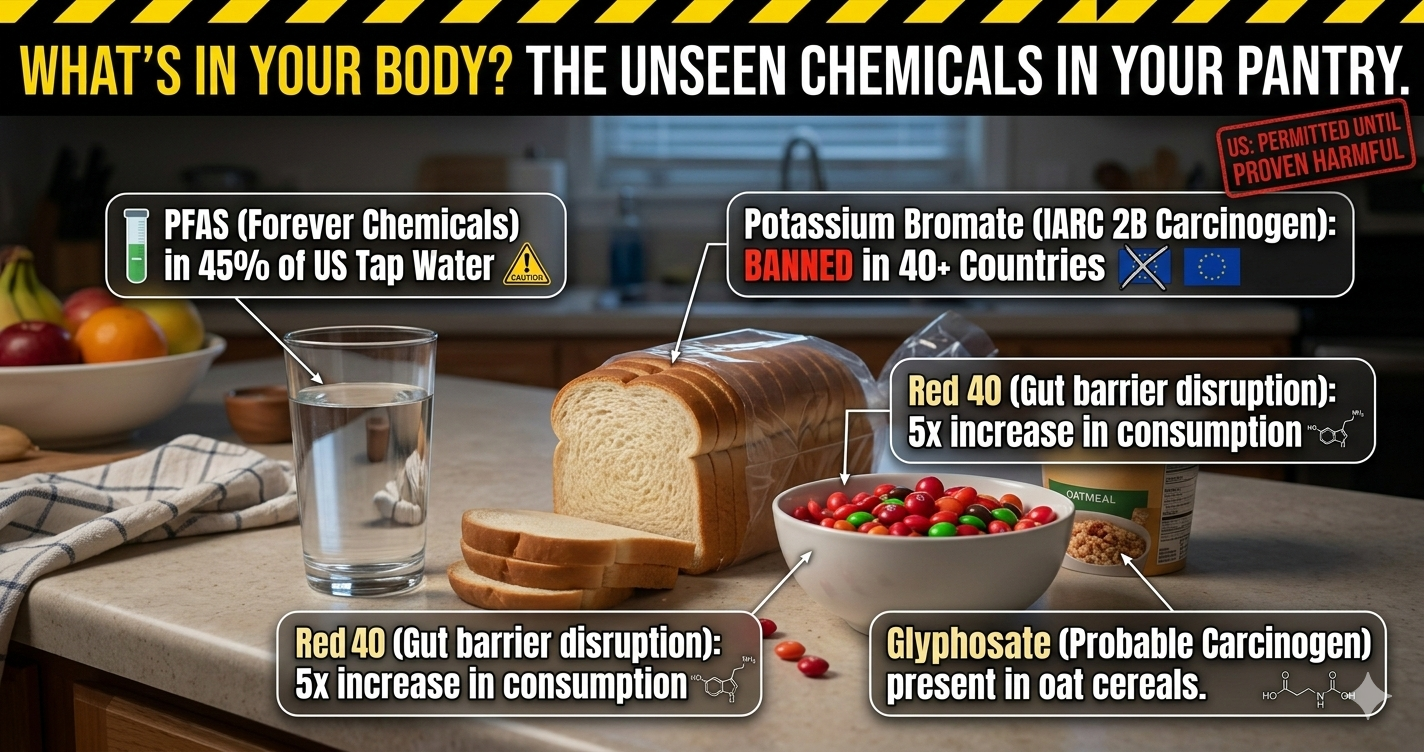
PFAS (per- and polyfluoroalkyl substances) are synthetic chemicals that never break down in the environment. They are detected in the blood of 97% of Americans. A 2024 study in Nature estimated PFAS in drinking water contributes to 4,626–6,864 cancer cases per year in the U.S. Approximately 172 million Americans live in communities where drinking water has tested positive for PFAS, and roughly 1 in 7 Americans have water exceeding the new federal limits.
Health effects with the strongest evidence
The C8 Science Panel — from a $343 million settlement after DuPont contaminated drinking water for 100,000+ people near Parkersburg, WV — studied 69,000 people and established "probable links" to six diseases: kidney cancer, testicular cancer, thyroid disease, high cholesterol, ulcerative colitis, and pregnancy-induced hypertension. A February 2026 study found PFNA and PFOSA — detected in 95% of Americans — are linked to accelerated biological aging in men aged 50–64.
They're in your cookware, clothing, and fast-food wrapper
Consumer Reports and Mamavation found PFAS in food packaging from McDonald's, Taco Bell, Starbucks, Jack-in-the-Box, and Burger King. A University of Notre Dame study found 52% of 231 cosmetics contained PFAS indicators — 63% of foundations, 55% of lip products. Even Oral-B Glide floss is made with PTFE, a PFAS compound.
The EPA's first-ever enforceable limits
On April 10, 2024, EPA finalized the first legally binding drinking water standard for PFAS: 4 parts per trillion for PFOA and PFOS — with a maximum contaminant level goal of zero, reflecting EPA's determination that "there is no level of exposure without risk." The Trump administration moved to rescind limits for several additional PFAS compounds and extended the compliance deadline to 2031.
DuPont knew PFOA was toxic since at least 1961. Internal documents showed the company dumped 7,100 tons of PFOA-laced sludge into unlined pits, secretly tested local water in 1984 confirming contamination, and did not disclose. Combined 3M and DuPont national water settlements now exceed $13.7 billion.
07
Titanium dioxide: banned in Europe for DNA damage, used in 13,000 U.S. products
Titanium dioxide (E171) is a whitening agent with no nutritional value, no preservative function, and no flavor — it exists in food purely for aesthetics. Approximately 13,000 U.S. food products contain it, including Skittles, Starburst, Trident White gum, Duncan Hines frosting, Chips Ahoy, Campbell's soups, and Lunchables. The EU banned it effective August 7, 2022, after EFSA concluded it "can no longer be considered safe as a food additive" because they could not exclude genotoxicity concerns.
The nanoparticle fraction of food-grade TiO₂ can traverse the intestinal barrier, pass into the bloodstream, and accumulate in the liver, intestine, and spleen. A 2022 study found DNA-damaging effects that were not reversible even after exposure ceased. Nanoparticles have been found in human placentae and infant meconium. IARC classifies titanium dioxide as Group 2B — "possibly carcinogenic."
The FDA approved TiO₂ in 1966 and last formally reviewed it in 1973. In April 2023, a coalition of EDF, CEH, CFS, CSPI, and EWG filed a citizen petition to revoke FDA authorization. The FDA is legally required to respond within 180 days but has not yet responded.
08
Potassium bromate and azodicarbonamide: banned worldwide, still in American bread
Potassium bromate (KBrO₃) is a powerful oxidizing agent that strengthens gluten and increases loaf volume. IARC classifies it as Group 2B — "possibly carcinogenic" based on research showing it induced kidney and thyroid tumors in rats. It is banned in the EU, UK, Canada, Brazil, China, India, South Korea, and many other countries. EWG has identified over 200 U.S. products still containing it. The FDA has not formally reviewed it since 1973 and since 1991 has merely "urged" bakers to voluntarily stop.
Azodicarbonamide (ADA) is a dough conditioner used in bread — and also in yoga mats and shoe soles. In February 2014, a petition targeting Subway's use of ADA collected over 78,000 signatures in 48 hours. Subway removed it within days. McDonald's, Wendy's, Chick-fil-A, and Dunkin' quietly followed. ADA is banned in the EU, UK, Australia, and Singapore (where it carries criminal penalties up to 15 years in prison). Its breakdown products include ethyl carbamate (IARC Group 2A — "probably carcinogenic"). The FDA still permits it at up to 45 ppm.
09
The nitrite paradox: "uncured" bacon may contain more nitrites than regular bacon
Sodium nitrite in processed meat forms N-nitrosamines — classified by IARC as carcinogenic or probably carcinogenic — when meat is cooked at high heat. In October 2015, IARC classified processed meat as Group 1 — carcinogenic to humans, with each 50-gram daily portion (about two slices of bacon) increasing colorectal cancer risk by 18%. Hot dogs typically contain the highest residual nitrite at 60–84 mg/kg.
The celery powder loophole: Products made with celery powder (which contains 20,000–50,000 ppm nitrate) are labeled "uncured" and "no nitrates or nitrites added*" with a tiny asterisk. A Journal of Food Protection study found "natural" hot dogs contained anywhere from one-half to 10 times the nitrite of conventional hot dogs. Harvard noted: "Ironically, even though celery powder is considered 'natural,' this food ingredient imparts more nitrates in the meat than the synthetic form." Conventional cured meats have defined nitrite limits; "uncured" meats with celery powder have no limits at all.
The EU published Regulation 2023/2108, reducing maximum nitrite levels in meat products and establishing mandatory residual-level monitoring for the first time. The U.S. allows 156 ppm sodium nitrite in most cured meats — significantly higher than new EU limits.
10
rBGH: the growth hormone most of America's milk has already rejected
Recombinant bovine growth hormone (rBGH/rBST) was approved in 1993 despite being banned in the EU (1990), Canada (1999), Japan, Australia, and New Zealand. Treated cows produce milk with elevated levels of insulin-like growth factor-1 (IGF-1) — identical in structure to human IGF-1. Monsanto's own 1993 UK application acknowledged a potential 500% elevation in IGF-1 levels. A Harvard study found women under 50 with the highest IGF-1 levels were 7 times more likely to develop breast cancer. A major Cancer Research study of 400,000+ participants confirmed links between elevated IGF-1 and colorectal, breast, and prostate cancer.
The market has largely self-corrected. By 2014, only 9.7% of U.S. dairy operations still used rBGH. Walmart, Kroger, Starbucks, Costco, Safeway, Ben & Jerry's, and Dannon now source rBGH-free milk. The "revolving door" controversy remains notable: Michael Taylor served as FDA Deputy Commissioner (overseeing rBGH labeling), was previously a Monsanto attorney, and later became Monsanto's VP for Public Policy.
11
Mercury in your corn syrup: the FDA study they tried to bury
In January 2009, FDA Environmental Health Officer Renee Dufault published findings that 9 of 20 HFCS samples (45%) contained detectable mercury. The source: the chlor-alkali process used to manufacture caustic soda and hydrochloric acid, both used in HFCS production. In 2003, EPA reported ~7 tons of mercury were "missing" from eight U.S. chlor-alkali plants annually.
A companion study tested 55 brand-name products with HFCS as the first or second ingredient and found nearly one-third contained detectable mercury, including dairy beverages, soft drinks, salad dressings, and barbecue sauces. Dufault discovered the contamination while at the FDA in 2004 but was told to drop the investigation. She left the FDA in 2008 to publish independently. The FDA has never conducted follow-up testing.
12
Carrageenan: the organic additive that causes inflammation in every animal study
Carrageenan is a thickener and stabilizer extracted from red seaweed, found in ice cream, yogurt, plant-based milks, processed meats, and infant formula. Dr. Joanne K. Tobacman of the University of Illinois has published over a dozen NIH-funded studies showing food-grade carrageenan causes intestinal ulceration, inflammation, reduced gut microbiota diversity, and increased intestinal permeability in laboratory animals. Degraded carrageenan is so inflammatory it is used as a standard laboratory tool to induce inflammation in animals for testing anti-inflammatory drugs.
In November 2016, the National Organic Standards Board voted 10–3 to remove carrageenan from the National List of allowed organic substances. In an unprecedented move, USDA Secretary Sonny Perdue's Agricultural Marketing Service overruled the NOSB in April 2018 and renewed carrageenan — the first time in 25 years of organic rulemaking that USDA ignored an NOSB sunset vote. Many organic brands voluntarily removed it due to consumer pressure, including Organic Valley, Stonyfield, and Eden Foods.
13
How the EU and US approach chemical safety is fundamentally different
The EU's precautionary principle holds that if a chemical is suspected of being harmful, it can be restricted until proven safe. The burden of proof falls on the manufacturer. The U.S. operates on the opposite presumption: chemicals are assumed safe until the government proves "unreasonable risk" — often requiring decades of exposure data and legal proceedings.
Metric
United States
European Union
Core principle
Innocent until proven harmful
Precautionary — restrict until proven safe
Cosmetics chemicals banned
~11–33
2,500+
Chemicals grandfathered without testing
~62,000 (1976 TSCA)
Must register under REACH
New chemicals: burden of proof
Government proves risk
Industry proves safety
New food chemicals since 2000
98.7% via self-affirmed GRAS
Formal pre-market assessment required
Glyphosate limit on oats
30 ppm
0.1 ppm
Under the original Toxic Substances Control Act (1976), the EPA grandfathered in ~62,000 existing chemicals without safety testing and managed to ban only 5 chemicals in 40 years. Under EU REACH (2006): "no data, no market" — industry must provide safety data before selling. Over 143,000 chemical substances were pre-registered. The EU's Candidate List of Substances of Very High Concern contains 250 entries as of June 2025.
14
Your pet's food may contain euthanasia drugs and 10× more lead than yours
The EU mandates that only material from animals that have passed veterinary inspection may enter the pet food supply chain. The U.S. FDA's own Compliance Policy states the opposite: pet food consisting of material from diseased animals or animals that died other than by slaughter "will not ordinarily be actionable" and "will be considered fit for animal consumption."
In February 2018, WJLA-TV found pentobarbital — the drug used to euthanize animals — in 60% of Gravy Train samples tested. The FDA confirmed contamination in products from J.M. Smucker (Gravy Train, Kibbles 'N Bits, Ol' Roy, Skippy) traced to a rendering facility which continued distributing contaminated products even after FDA notification.
The Clean Label Project's February 2026 study of 79 top-selling dog foods found dry kibble contained on average 12.7× more lead and 5.7× more arsenic than human-grade food. One dry food contained 780 ppb acrylamide — equivalent to a person eating five servings of french fries daily. Yet the FDA's action level for lead in pet food is 10,000 ppb — compared to 5 ppb in bottled water and 20 ppb in children's cereal.
15
The precautionary toolkit: apps, filters, and labels that actually protect you
Five apps worth downloading
Yuka
Scans food and cosmetics barcodes; scores 0–100. 6M+ products, 80M+ users. 100% independent — no brand sponsorship.
EWG Healthy Living
Integrates four databases — Skin Deep, Food Scores, Cleaning, Sunscreen. 100,000+ personal care products and 80,000+ foods.
Bobby Approved
Binary approved/not-approved for 100+ harmful ingredients. Highlights harmful ingredients in red with linked studies.
Think Dirty
Cosmetics scanner with 2M+ products. Automatically elevates risk for products listing "fragrance."
CSPI Chemical Cuisine
The most authoritative independent food additive safety reference, maintained since the 1970s. Rates additives from "Safe" to "Avoid."
What organic certification actually protects against
Organic certification completely prohibits synthetic herbicides (including glyphosate), all synthetic food dyes, BHA/BHT/TBHQ, artificial flavors, GMOs, antibiotics, and growth hormones. It partially protects against PFAS (biosolids banned, but environmental contamination can still reach organic farms) and heavy metals. It does not protect against BPA/phthalates in packaging, fluoride in water, or food contact chemicals.
Water filtration is non-negotiable
For fluoride and PFAS removal, only reverse osmosis systems and specialized media reliably work. Standard carbon filters do not remove fluoride. Top-rated options include the AquaTru Classic (countertop RO, NSF 42/53/58/401 certified, 97.5%+ PFAS reduction, removes fluoride, ~$100/year operating cost) and the Clearly Filtered Pitcher (NSF 42/53/401/473 certified, 100% PFAS reduction in EWG testing, targets 365+ contaminants including fluoride and glyphosate). Always verify NSF/ANSI 58 certification specifically for PFAS.
The label red flags that matter most
Avoid products listing BHA, BHT, TBHQ, sodium nitrite/nitrate, potassium bromate, azodicarbonamide, any FD&C color followed by a number, brominated vegetable oil, or propylparaben. Be skeptical of "natural flavors" (which can contain 100+ undisclosed chemicals), "natural" (no FDA definition), and "uncured/no nitrates added" (the celery powder loophole). Look for USDA Certified Organic, EWG VERIFIED, Non-GMO Project Verified, and Glyphosate Residue Free certifications.
What the chemical gap really means
The distance between what science knows and what American regulators do about it continues to widen. A single number captures the absurdity: the EU has banned or restricted over 2,500 chemicals in cosmetics alone while the FDA has banned roughly 11.
The GRAS loophole allows industry to self-certify chemicals as safe without telling the FDA they exist. EPA tolerance levels for glyphosate were repeatedly raised at Monsanto's request. The NTP's fluoride report was suppressed for years by the very agencies promoting fluoridation. DuPont knew PFOA was toxic for decades before the public learned the truth.
The state-level rebellion is accelerating — California, West Virginia, Utah, Arizona, Virginia, and others have enacted laws the federal government won't. The FDA's 2025–2026 actions on Red 3 and BHA represent the most significant federal movement in decades. But the voluntary dye "phase-out," the absence of enforceable timelines, and proposed FDA budget cuts of 17% suggest the structural incentives haven't fundamentally changed.
The most effective protection remains individual action: choosing organic for grains and produce, filtering your water with a certified RO system, scanning products with apps like Yuka and EWG, reading ingredient labels, and supporting the advocacy organizations that have done more to move the needle than decades of federal regulation. The chemical gap won't close on its own.